


Saudization compliance has become one of the hardest parts of running a team in Saudi Arabia. The Developed Nitaqat programme now measures your whole entity, its targets rise as you grow, and new profession quotas keep landing — from engineering and project management to procurement and sales.
Under that pressure, a shortcut keeps coming up in conversations with HR and finance teams: move expat employees onto another company’s sponsorship — a manpower supplier, an “Employer of Record” or a partner firm — keep them working exactly where they are, and let the other company “carry” them on its Nitaqat. This guide explains what Saudi rules actually say about that, what it costs when it goes wrong, and the compliant ways to add capacity without hurting your Nitaqat band.
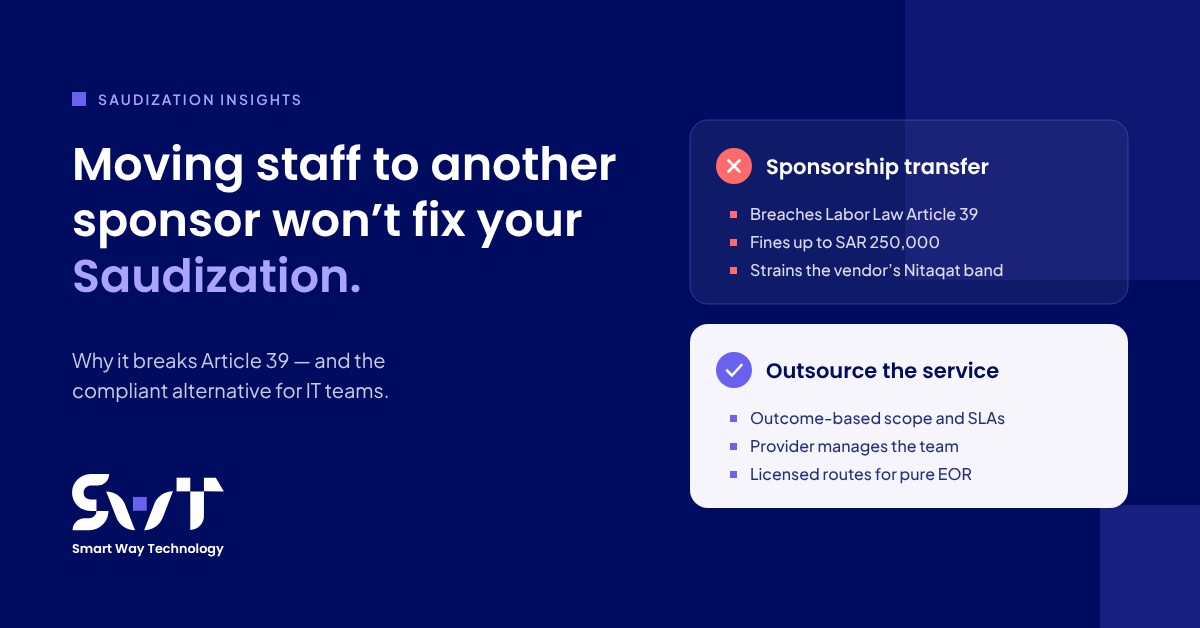
Short answer: Moving expat staff onto another company’s sponsorship while they keep working for you breaches Article 39 of the Saudi Labor Law, and supplying workers to other businesses requires an MHRSD licence. Even through a licensed provider, supplied workers can still count in your Saudization base. The compliant routes are a licensed HR company, Ajeer for temporary needs, or genuinely outsourcing the service.
Why Saudization compliance is getting harder in 2026
MHRSD issued the procedural guide for the Developed Nitaqat programme on 22 January 2026, covering April 2026 to December 2028. Three changes matter most for employers:
- Entity-level calculation. Nitaqat now assesses every branch that carries out the same economic activity together, and the required ratio rises with your headcount instead of following fixed bands.
- Tighter band restrictions. Low Green now suspends new visa applications and profession changes. Red also suspends service transfers and the issuing or renewal of work permits.
- Salary-weighted counting. A Saudi employee earning SAR 4,000 or more counts as one; SAR 3,000 to 3,999 counts as half; below SAR 3,000 does not count.
Profession quotas sit on top of Nitaqat. These are the ones that hit technology and project teams hardest:
| Roles | Saudization target | Applies when | Effective |
|---|---|---|---|
| Engineering (46 professions) | 30% | 5+ engineers; Saudi salary of at least SAR 8,000 and Saudi Council of Engineers accreditation | Already applies |
| Engineering technicians (94 professions) | 35% | 5+ workers in these roles | 9 May 2027 |
| Project management | 70% | 3+ employees in project-management roles | 14 February 2027 |
| Procurement and supply chain | 70% | 3+ employees in these roles | Already applies |
| Sales and marketing | 60% | 3+ employees; Saudi salary of at least SAR 5,500 | Already applies |
Sources: Al Tamimi & Company, Clyde & Co and Al-Madina.
The sponsorship transfer shortcut: what it looks like
The arrangement usually works like this:
- An expat employee’s services are transferred to Company B — often presented as manpower outsourcing or an Employer of Record service.
- Company B becomes the employer on paper: iqama, GOSI registration, payroll and work permit.
- The employee keeps working for Company A, under Company A’s managers, on Company A’s projects.
- Company A pays Company B a monthly fee per head.
The appeal is easy to see: fewer expats in Company A’s Nitaqat calculation, less HR administration and, supposedly, less liability. Each of those benefits rests on an assumption the rules don’t support.
Is sponsorship transfer allowed under Saudi labor law?
Article 39: employees work for their own employer
Article 39 of the Saudi Labor Law prohibits an employer from letting its worker work for others, prohibits a worker from working for another employer, and prohibits employing another employer’s worker — unless the prescribed regulatory rules and procedures are followed. A “paper” sponsorship transfer, where the employee keeps working for the original company, runs into all three prohibitions at once.
Manpower supply is a licensed activity
MHRSD’s Rules for Practising Recruitment and Labor Services limit labor supply to licensed categories — human-resources companies, recruitment companies and recruitment offices. Licensed companies must be Saudi joint-stock companies with paid-up capital and bank guarantees that run into the millions of riyals. A typical trading, consulting or technology company doesn’t hold this licence, and the rules prohibit a licence holder from letting anyone else use its licence.
Do outsourced workers count in Nitaqat?
Often, yes. The same rules state that workers a licensed provider supplies to a client are counted within the workforce used to calculate Saudization ratios, unless the Ministry sets different counting rules. So manpower outsourcing is not a reliable way to improve your Nitaqat band. Confirm how a specific arrangement will be counted with MHRSD before you rely on it.
Penalties for unlicensed manpower supply in Saudi Arabia
Getting Saudization compliance wrong through an unlicensed arrangement is expensive for both sides:
- Fines. Under the updated violations table approved in 2026, practising recruitment, employment or subcontracting without a licence is classed as a serious violation, with reported fines of SAR 200,000–250,000.
- Per-worker penalties. Draft updates published in 2025 proposed SAR 10,000–20,000 per worker for letting a worker work for another party.
- The receiving company’s Nitaqat. Every expat a company absorbs lowers its own Saudization ratio. In the Red band it can’t renew work permits for its existing expat staff, receive service transfers or obtain new visas.
- Employer liability. Wages, end-of-service benefits, iqama renewals, work-permit fees, occupational-hazard cover and labor disputes all sit with the employer on record — even when someone else directs the work.
- Procurement risk. Banks and government entities vet their suppliers’ labor compliance. An arrangement that looks like a way around Saudization can cost you a tender.
Employer of Record in Saudi Arabia: does it help with Nitaqat?
An Employer of Record (EOR) is only legitimate in Saudi Arabia when the employing company holds the right MHRSD licence — many global EOR platforms work through a licensed local partner. Ask to see the licence of the company that will actually employ your staff, and check its Nitaqat band before signing — your Saudization compliance partly depends on theirs.
An EOR helps when you don’t have an entity yet or want payroll and HR administration handled for you. It doesn’t automatically remove those workers from your Saudization base. As one market-entry guide puts it, “Saudization cannot be avoided by relabeling employment” (Vision2030.ai). Published EOR fees in Saudi Arabia start at around SAR 1,875–3,000 per employee per month (Masdar EOR).
Compliant routes: manpower outsourcing vs managed services
If you need capacity without adding to your own headcount, there are three legitimate routes. Each fits a different need.
| Route | How it works | Best for | Watch-outs |
|---|---|---|---|
| Licensed HR company (manpower outsourcing / EOR) | An MHRSD-licensed HR company employs the worker and contracts with you on the Ministry’s approved template. | People you need employed on your behalf, long term. | Ask to see the employing company’s licence. Supplied workers may still count in your Saudization base. |
| Ajeer | MHRSD’s platform for lending workers temporarily between establishments, plus certain contracting arrangements. | Short-term or seasonal needs. | Lending is capped at six months per worker, and both establishments generally need a Low Green band or above. |
| Managed IT services | A provider delivers a defined scope — support, operations, development — under an outcome-based contract and SLAs, with its own team and management. | Ongoing IT functions you don’t need to staff in-house. | The provider must genuinely manage the work and own the results. |
How to improve your Nitaqat band the right way
Sustainable Saudization compliance comes from how you hire, pay and structure work — not from where your staff are sponsored:
- Check your entity, not just one branch. Review your band in Qiwa across every branch with the same activity before visa or renewal cycles.
- Plan around profession quotas. Map engineering, project-management, procurement and sales roles against the targets above before you hire.
- Pay Saudi talent at the full-count level. Salaries of SAR 4,000 or more count as one full Saudi employee in Nitaqat.
- Outsource functions, not people. Move whole services — application support, operations, development — to a provider that runs them end to end.
- Use Ajeer only for temporary peaks. It is designed for short-term lending, not as a permanent home for your team.
Outsource the service, not the people
For most IT leaders, the real problem isn’t sponsorship. It’s needing specialist capability — ERP support, data engineering, integration, application maintenance — without building and carrying a large in-house team. IT outsourcing through managed services addresses that directly:
- You buy an outcome — an application supported, a platform operated, a project delivered — measured by service levels, not headcount.
- The provider recruits, manages, retains and replaces the team.
- Your own hiring can focus on the roles you want to localize and grow.
- Contracts are transparent and easy for procurement and auditors to review.
The policy direction favours in-Kingdom providers too. The Federation of Saudi Chambers is studying how to bring IT, shared-services and other outsourced work now handled abroad back to providers inside the Kingdom, and the Local Content and Government Procurement Authority has added local-content weighting to the evaluation of IT service tenders (Arab News).
What makes a managed-services arrangement compliant
- A written scope of work with defined deliverables and service levels.
- The provider supervises its team and is accountable for the results.
- Pricing is tied to services or deliverables, not to “renting” named individuals.
- Any work at your premises is documented through the approved channels.
For a deeper look at engagement models, see our guides to permanent hiring vs contract staffing, the cost of hiring a technical team in Saudi Arabia and how to choose an IT staffing partner.
How Smart Way Technology can help
Smart Way Technology delivers managed IT services and project-based teams for enterprises and government entities across Saudi Arabia — from Oracle E-Business Suite and BI support to data platforms, integration and application development. We build Saudi talent into our delivery teams, work to clear SLAs and take responsibility for the outcome, so you get the capability without carrying the Saudization compliance load.
Talk to our team about outsourcing your next IT function.
Frequently asked questions
Can a company transfer its employees to another company’s sponsorship and keep them working?
Not as a standing arrangement. Article 39 of the Labor Law prohibits working for anyone other than your employer outside approved procedures, and supplying workers to other businesses requires an MHRSD licence.
Do outsourced workers count in Nitaqat?
Workers supplied by a licensed provider are counted within the client’s Saudization base unless the Ministry sets different rules, so outsourcing people is not a reliable way to raise your band. Confirm the treatment of your arrangement with MHRSD.
Can an Employer of Record improve my Nitaqat band?
Don’t assume it will. An EOR must be a licensed HR company, and the workers it supplies may still count in your Saudization base. It is best used when you lack a local entity or want HR administration handled.
Is manpower outsourcing legal in Saudi Arabia?
Yes, through MHRSD-licensed human-resources and recruitment companies using the Ministry’s approved contract. Practising it without a licence is a serious violation.
What is Ajeer?
Ajeer is an MHRSD platform for temporarily lending workers between establishments and for certain contracting arrangements. It is subject to Nitaqat band, quota and duration limits.
Is IT outsourcing compatible with Saudization compliance?
Yes, when it is a genuine service contract: the provider manages its own team, is accountable for the results, and the arrangement is properly documented.
Sources
- MHRSD — Saudi Labor Law, employment of non-Saudis (Articles 32–39) (Arabic)
- MHRSD — Rules for Practising Recruitment and Labor Services (PDF, Arabic)
- MHRSD — Developed Nitaqat procedural guide 2026 (PDF, Arabic)
- Al Tamimi & Company — Saudi Arabia’s 2026–2027 Saudisation overview, 22 September 2026
- Clyde & Co — Developed Nitaqat Programme: key updates, 25 June 2026
- Okaz — Labor Law violations table approved, 12 July 2026 (Arabic)
- Okaz — Draft update to Labor Law violations, 15 September 2025 (Arabic)
- Al-Madina — Saudization of 94 engineering-technician professions raised to 35%, 9 November 2026 (Arabic)
- Arab News — Saudi Arabia is moving to bring outsourced jobs back into the Kingdom, 8 September 2026
- Smasco — Ajeer platform: services and conditions (Arabic)
- Vision2030.ai — Employer of Record in Saudi Arabia, May 2026
- Masdar EOR — Hire employees in Saudi Arabia without a local company, July 2026
This article is general information, not legal advice. Saudi labor regulations change frequently; confirm your specific situation with MHRSD or a qualified legal adviser.
Not sure which solution fits your needs?
Every engagement is scoped to what you actually need. Tell us a bit about your goals and we will get back to you with the right approach.


Leave A Comment